Five of My Favorite Papers and the Stories Behind Them
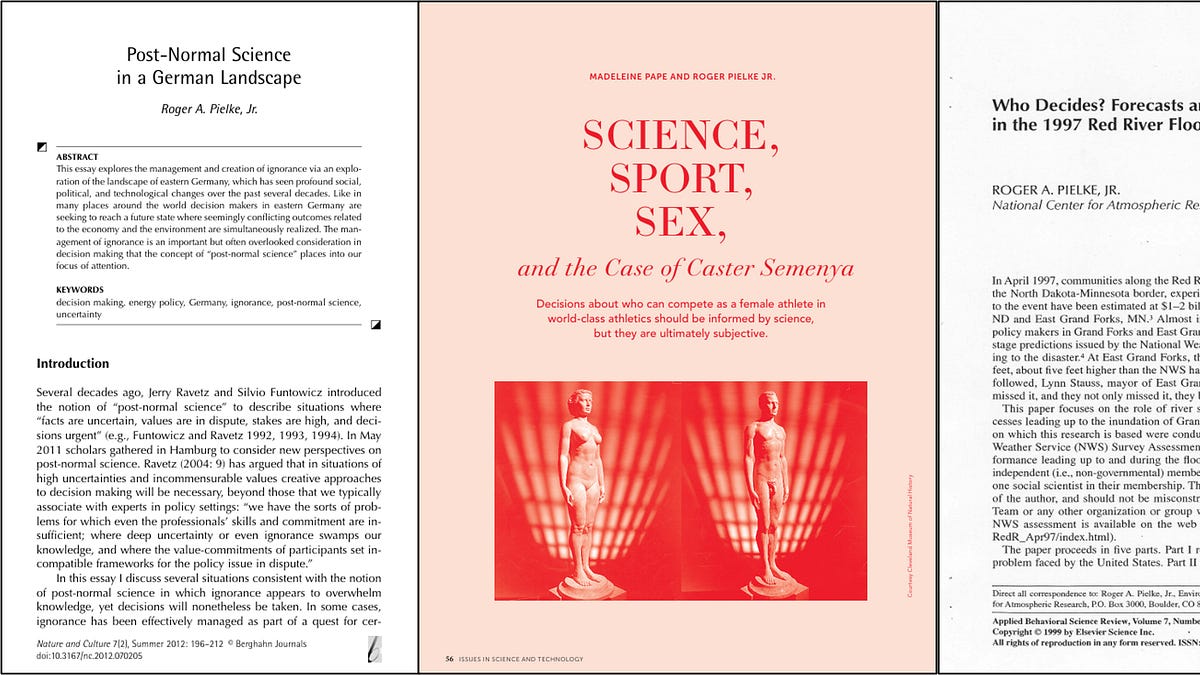
Five of My Favorite Papers and the Stories Behind Them Each of them - Free to read I first published this post for THB paid subscribers. I am freeing it from the paywall, lightly edited. Enjoy! When I decided to leave academia, a few years ago, I was 55, which was exactly the median age of U.S. tenure-track faculty. In theory, that means I was mid-career, and in practice that seems about right! Even so, leaving academia gave me a chance to look back at my work over the past 30 years, since getting my PhD in 1994. I set out to write a post about my five favorite papers I’ve authored or co-authored over that time. However, it turns out that I have more than five favorites! So today I am sharing five of my favorite papers, and will do another post like this down the road. Why these five papers? These are certainly not my most read or most cited papers. I have applied two criteria: First, these papers made what I see as really novel arguments, and Second, these are ones that I can still recall the intense feeling of learning and clarity while writing. That is a hard feeling to explain. The closest thing I can compare it to is the feeling of being in “the zone” when playing a competitive sport. When asked about how one gets into “the zone,” Michael Jordan explained: "I don't think anyone knows. I think it happens when you put forth the work ethics. You know, and then next thing you know, you are achieving what you always worked hard to get, but you can't get it without putting forth the work." That sounds right to me. Today, I share these papers (with ungated PDFs) from the zone and and also share the inside backstory to each. Note: Don’t forget the huge THB discounts for students and military/government. Pielke Jr., R. 1999. Who Decides? Forecasts and Responsibilities. Applied Behavioral Science Review, 7:83-101. Backstory In spring 1997, there was massive flooding along the Red River of the North which flows south to north between North Dakota and Minnesota. Fargo and Grand Forks experienced massive destruction. In the weeks following, I was invited by the U.S. National Weather Service to serve on its disaster survey team. The main focus of our inquiry was how it could be that a flood that was well-forecasted, months in advance, resulted in emergency evacuations in the middle of the night in communities seemingly unprepared, despite the advance warnings. Our team went to North Dakota and Minnesota, where we had a chance to interview forecasters, elected officials, emergency managers, and members of the public. The experience for me was career changing — driving home the fact that even the very best science doesn’t matter unless it is effectively used in decision making. This paper was the result of my efforts to make sense of how an accurate forecast could be coupled with disastrous outcomes. You can see our survey team’s official NWS report here. Sometime, I’ll do a full public post on the incredible experience. Postscript: I’m not 100% sure, but I am pretty confident that it was this paper that brought my work to the attention of Nate Silver who discussed it in his book, The Signal and the Noise: Why So Many Predictions Fail, But Some Don’t. Nate then hired me at 538 in 2014 to write on science (and sports) and then quickly dropped me after a Twitter cancellation campaign by activist climate scientists, journalists, and randos. But that is another story. Pielke, R. A. 2012. Post-normal science in a German landscape. Nature and Culture, 7:196-212. Backstory This paper reflects my exploration of how we make decisions in the face of ignorance, which I characterize in the paper as the “neglected sibling of uncertainty.” I have been fortunate over the decades to have spent a lot of time in Germany, and to observe its efforts to decarbonize its economy in the face of incredibly complex politics — characterized as the energiewende (energy turnaround). I decided the write the paper after Matthias Groß, a German colleague, took me on a tour of the human-made lakes south of Leipzig (see the contemporary video above), which were created from open-pit lignite (coal) mines. I can vividly recall the beautiful setting, with wind turbines slowly spinning on the horizon, and trying to reconcile the challenges of economic development, energy security, environmental policy (including climate), and incredibly complex politics. I remember thinking — no one knows how to do this, and yet we must. This paper was the result of my thinking through these issues. Ignorance is both pretty common and a surmountable obstacle to effective decision making. The paper concludes: Sitting there in the gentle breeze in the transformed landscape enjoying my lunch and conversation with Matthias Groß I could almost imagine that Germany had figured out something really important about innovation, democracy, and building a better, shared future. Almost. Pielke Jr, R., & Linnér, B. O. 2019. From Green Revolution to Green Evolution: A critique of the political myth of averted famine. Minerva, 57:265-291. Backstory This was an extremely fun paper to research and write, and is co-authored with my friend and colleague Björn-Ola Linnér, who has written an excellent book on Malthusianism. This paper had a much longer gestation than any paper I’ve written, having been started in 2011 during an extended stay in Linköping, Sweden, but not published until 2019. Not only was the research quite intensive, but during the writing my career was interrupted by the 538 cancellation campaign, attack by the Obama White House, and congressional investigation. Ironically, this paper marked an effort to start diversifying my work beyond climate in the midst of relentless attacks and efforts to derail my career by academic colleagues. When I did step away from climate research for several years, I had an opportunity to finalize this paper, which really helped me to better understand the population scares of the 1960s and 1970s, as well as the so-called “Green Revolution.” I learned that the stories we tell in academia — simply because we have heard them uncritically so many times — are not always grounded in reality. In this case, the “Green Revolution” is far more complicated than Norman Borlaug (a great man to be sure) saving the world from famine. The detail in this paper about Indira Ghandi and Lyndon Johnson conspiring to fool the world is a doozy. Pape, M., & R. Pielke Jr. 2019. Science, sport, sex, and the case of Caster Semenya. Issues in Science and technology, 36:56-63. Backstory In February, 2019, I served as a pro bono expert witness in the arbitration case of Caster Semenya vs. the International Association of Athletics Federations (IAAF), in Lausanne, Switzerland. I came to be a witness based on research (with Ross Tucker and Erik Boye) that had identified egregious data errors in a paper the IAAF was using to ban athletes from competing at the distances that Semenya ran (and only those distances). Those errors were obvious, admitted to by the IAAF, and consequential — yet the journal that published them refused to retract the paper, but I digress. Later in 2019, I was invited by the government of France to participate in a symposium following up the arbitration (which Semenya lost in a 2-1 decision), which included experts from both sides of the case. Imagine my surprise when I saw the lead IAAF expert presenting a slide (shown above) with more false information. Here we go again, I thought. At that symposium I met Madeleine Pape, who had just completed a PhD in the sociology of science (and happens to be an Olympian who competed against Semenya). We decided to collaborate on what would become this paper, which explores how science is created in support of a political agenda — which this case demonstrates clearly. Specifically, in order to study differences between men and women, researchers need to first classify men and women. If this research is then used to justify how to classify men and women, we arrive at complete circularity — it is not the research that dictates the classification, it is pre-research classification. More recently, I’ve come to call this dynamic tactical science. Postscript: The paper that we identified the errors in and which was used to justify gender regulations underwent a “massive correction” (the last sentence in that Retraction Watch article is a zinger). Pielke, R. (2018). Opening up the climate policy envelope. Issues in Science and Technology, 34(4), 30-36. Backstory This paper marked my decision to return to climate research again in 2018, after taking several years away. I was asked to give a talk in Tokyo and this paper was the result. It turns out that the cancellation campaign against me was actually fortunate — It gave me motivation to develop new emphases in my research, allowing me to explore new areas and meet many wonderful new people. It also allowed me to take a fresh look at climate science and policy after some time away. One important motivation for the fresh look was the work of Justin Ritchie (who since has become a valued collaborator) which led to many “Aha!” moments. I also learned that I can’t be cancelled. THB exists because of these experiences. With hindsight, this paper provided a roadmap for my extensive work (especially with Ritchie and Matt Burgess) on climate scenarios that THB readers have become very familiar with over the years. I write in this paper: Scenarios are essential because to move into the future intentionally we need some expectation of how actions and outcomes may be related. But scenarios may become captured by assumptions and beliefs about how the world does or should work, and thus can limit our vision of possible futures, and make us vulnerable to surprises. Postscript: It is no surprise that this is the second paper of the five that appeared in Issues in Science and Technology. That is no doubt thanks to the former editor of IST, Dan Sarewitz, whose editing makes everything better. Thanks Dan! Comments welcomed! Before you go: To support THB, please click that “❤️ Like” button. More likes means more readers of THB. Thanks!
~7 min read · 1712 words