Why Don’t We Live in an Art Nouveau World?
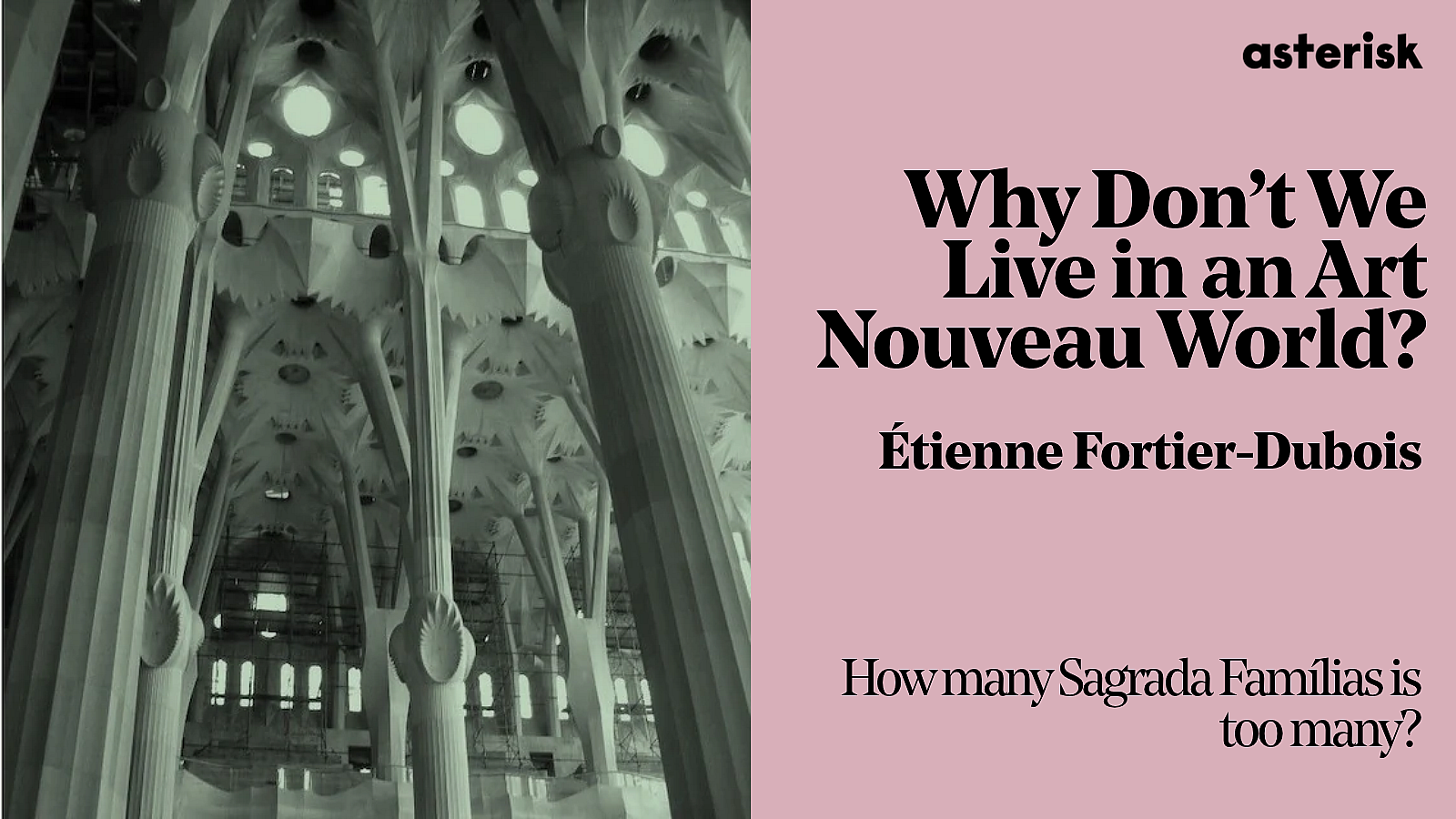
A hundred years after the death of its architect and 144 years after the start of construction, the Sagrada Família’s main spire was completed this February, making it the tallest church in the world. In addition to being the tallest, it is also one of the most bizarre. It looks like no other building, anywhere. The Sagrada Família is an expression of Antoni Gaudí’s very personal view of architecture, which incorporates Gothic elements into Modernisme,1 the Catalan version of Art Nouveau. The whole thing vaguely resembles a termite mound. The two completed façades are covered with countless sculpted ornaments in multiple styles (the third and main façade’s construction is still pending, and it will require demolishing some apartment blocks). The interior is an airy forest of stone columns that rise to meet a vaulted ceiling like the branches of trees in a canopy, bathed in the multicolored light of the stained glass windows. Trencadís, a mosaic technique that uses irregular pieces of glass, is used abundantly. Since 2005, the church has been recognized as a UNESCO World Heritage Site.2 Most people think this is incredibly beautiful. Every now and then, and especially this year, the Sagrada Família makes the rounds on social media. Tourists flock to Barcelona just to see it, along with other Modernista works of architecture. I did that three times, also visiting Gaudí’s intriguing Park Güell and his curvy apartment buildings like the Casa Batlló and Casa Milà, as well as works by other architects of the movement like the Palau de la Música Catalana, designed by Lluís Domènech i Montaner. All of that is wondrous; it is also, like most Art Nouveau, somewhat strange. This movement, whose name means “new art” in French, was a deliberate attempt to create an innovative aesthetic across the fine arts, the decorative arts, and architecture around 1890 to 1910. In architecture, Art Nouveau was a break with the general background of historicism, the dominant tendency in the 19th century to build with an outlook to the past, constituted of various “revivals” — Neo-Gothic, Neoclassical, Renaissance Revival, etc. — as well as eclectic and mixed styles like Beaux-Arts. Art Nouveau began in Brussels, pioneered by architects such as Victor Horta and Henry van de Velde. The style soon spread to Paris and the rest of Europe, spawning national variants that are often called something like “modern style” or “new style.”3 Some of them, like Catalan Modernisme, are highly specific to their region, but the style overall carries a fondness for curves, asymmetry, and abundant ornamentation, often inspired from plants. Art Nouveau and its regional variants are often contrasted with the more angular and mineral aesthetic of Art Deco styles, which flourished in the 1910s to 1930s, most notably in France and the United States. One result of Art Nouveau’s anti-historicist stance is that it does not quite match the older architecture of Barcelona or anywhere else. It is also, obviously, very different from what we usually call modernism — the minimalistic, non-ornamented form of architecture that has come to dominate anything built after the middle of the 20th century. Art Nouveau sits between historicism and modernism as a whimsical,almost utopian style. Today it is still beloved, but rarely built. Why isn’t there more? Why are only a small fraction of Barcelona’s buildings Modernista?4 Indeed, why do only a few cities in the rest of Europe — Riga, Brussels, Vienna, Budapest, Nancy — have strong Art Nouveau traditions, and even in those cities, why does it remain a minority style? This is an interesting question in part because of a common view of the history of architecture that has started to proliferate on social media, especially among a certain conservative, “trad” demographic. For centuries, the argument goes, humanity infused its buildings with beauty, decorating them with ornament and remixing classical knowledge accumulated across generations. This practice last flowered in the early 20th century with Art Nouveau and Art Deco, both of which are still admired today. But immediately after that, circa 1940 to 1950, humanity turned its back on all this beauty and decided to do plain, unornamented, ugly modern buildings everywhere, forever. Let’s call this the trad critique of architecture. The trad critique is an oversimplified, naïve account, smuggling in a lot of questionable assumptions. But it does point to a real puzzle. If, as proponents of this viewpoint believe, most people prefer older-styled, ornamented constructions over modern ones,5 why are rich countries today — with greater means to achieve their goals than any previous society — mostly building the latter? It is an extremely difficult problem, not because we can’t think of any answers but because we can think of too many. There are dozens of plausible explanations: cost of labor, cost of materials, changing tastes, elite status games, misaligned market incentives, architect credentialism, disdain for pastiche, high demand for large windows, software constraints, short project timelines, excessive building regulation, NIMBYism, the global monoculture, atonement for the horrors of war, you name it.6 I harbor no illusions of solving it, but maybe we can make some progress by examining one clear case study: the excesses of Catalan Modernisme and its quick transition to the more sober Noucentista style. A 15-minute walk from the Sagrada Família, the Hospital de la Santa Creu i Sant Pau is another Modernista complex, and arguably an even more interesting one than the big tall church. Sant Pau was built from 1901 to 1930 under the architectural direction of Lluís Domènech i Montaner. It was a replacement for the medieval, and very obsolete, Santa Creu hospital; Pau Gil, a rich banker, provided the necessary funds in his will. It served its purpose for a century before closing in 2009, when its medical functions moved to a new hospital with the same name nearby (built, of course, in a clean, unornamented contemporary style). The old hospital, by then also a UNESCO World Heritage Site, was converted into a tourist attraction and office space. On my third visit to Barcelona, I made a point of visiting it. I wanted to see what a beautiful hospital was like — one that at least tried to counteract the inherent dreariness of such places, which are filled with sickness and pain, by surrounding it with pleasant architecture and decoration. But I left Sant Pau with mixed feelings. To be sure, it absolutely is the most beautiful hospital I have ever seen. It consists of several above-ground pavilions, each filled with the signature moves of Catalan Modernisme and international Art Nouveau: rich, colorful ornament, from mosaics to stained glass to sculpture; motifs inspired by flowers and nature, but also neo-Gothic elements like turrets and crenelations, harking to Catalonia’s medieval golden age; just the right amount of asymmetry. The wards for the sick are filled with light and lined with tasteful green and floral tiles. A network of utilitarian tunnels links the buildings together. There are orange trees everywhere. Yet in some sense Sant Pau was a little disappointing. This is partly due to the fact that all this beauty has been replaced by a new facility with presumably normal (i.e., modest) amounts of hospital beauty. You sort of get why they had to do this, though. The historic Sant Pau is clearly outdated as a medical facility, and it’s frankly surprising it kept functioning into the 21st century. More disillusionment occurred when I learned that the most ornate pavilion, lavishly decorated with mosaics and colored glass, was not for the sick — it was the administration building. It turns out that during construction, a conflict erupted between the leadership of the old hospital on one hand and Pau Gil’s will executors and their architect on the other. According to twoarticles by the hospital’s archivists, the hospital leadership wanted to quickly build the operational infrastructure (the quarters for the religious order providing the care, the kitchen, the pharmacy, and so on) to transfer operations as fast as possible and to keep fulfilling their mission of serving the poor. The other party wanted to honor Gil’s wish of creating a distinct, prominent hospital as an architectural statement, starting with the administration building as a showpiece. The latter group won, which is why there’s an architecture masterpiece in Barcelona that we can visit. However, this had the unfortunate consequence that some of the pavilions built later are less elaborate, because the project was running out of money.7 So we can dispel the thought that everyone just prioritized aesthetics more in the Art Nouveau era. Disagreements pitting utility against beauty were definitely normal then too, and I’m not sure I would have necessarily sided with the architect and executors if I had been there. Most importantly, my visit to Sant Pau made me like Modernisme less. I quickly got over it. I got the sense that it was built to create a “wow” effect, and to be sure I was “wowed,” but the beauty quickly faded after direct contact. Some of this was due to unmet expectations: Online postcard-perfect pictures, some of which are artificially saturated to heighten the colors, created a fairy-tale mental image that wasn’t quite matched by the real place. Some of it was habituation: The novelty of all those ornaments, and the contrast with the more ordinary architecture of the city around it, just didn’t register as much after half an hour in the complex.8 And some of it was that the ornamentation created a cognitive load: It got more tiring than restful after I had become habituated. What I liked most, in the end, were the orange trees. This is in agreement with the scholarly evidence on hospital architecture, which suggests that natural elements contribute most to the well-being of patients. The solariums and garden-like design of Sant Pau were indeed wonderful, but those features are only tangentially related to Modernisme. Gaudí’s idiosyncratic masterpieces left me with a similar impression. They’re great, but would I want to see them every day? Not particularly. Do I wish that there were more of them in Barcelona, or in other places? Not really. I’m glad Modernista architecture exists, and I’m glad we have the Sagrada Família as an absurdly ambitious experiment, but my feeling is that there is just the right amount of this style in the world. I wouldn’t wish for an entire city to look like this. Art Nouveau was a short-lived movement. The earliest building to be included within Modernisme is the Castle of the Three Dragons, built by Domènech i Montaner in 1888 — it is not quite Art Nouveau yet in the usual sense, but clearly reaching for something new. In Brussels, the first houses to belong to Art Nouveau proper date to 1893. By the mid-1900s, the reaction against the style had already begun in most places where it existed at all, and after the First World War this reaction would be recognized as part of a conservative “return to order” movement, which emphasized sober classicism and historicism. It seems that people got tired of Art Nouveau fast, like I did. As a result, we never got an entire Art Nouveau city. The closest thing is perhaps Riga, the capital of Latvia, which happened to experience fast growth during the Art Nouveau era. The population roughly doubled between 1897 and 1913, while it was part of the Russian Empire, and a fair amount of the new construction was built in the style, locally called Jūgendstils. Today, the collection of approximately 800 Art Nouveau buildings in Riga is considered the most concentrated anywhere, constituting a third of the city center. But even this is not quite the same as making up the fabric of the city. Moreover, the phrase “Art Nouveau” hides significant variation, much of it closer to traditional architecture than to the fancifulness of Catalan Modernisme. The “Eclectic Art Nouveau” façades of apartment buildings designed by Mikhail Eisenstein, especially those on Albert Street built between 1901 and 1906, are famous. Yet there are few examples of this style, as the façades were quickly criticized by contemporaries as too elaborate,9 and after 1907 Jūgendstils evolved toward sobriety, geometry, and classicism.10Most of the 800 buildings belong to the “Perpendicular,” “National Romantic,” or “Neoclassical” Art Nouveau, only some of which feature heavy ornamentation. Another city with a strong Art Nouveau tradition is Nancy, in France, where industrialists and artists relocated after the loss of Alsace and some of Lorraine to Germany in 1871, bringing in talent and money. The École de Nancy flourished between 1894and 1914, mostly centered on furniture and design but also on architecture. Led by a group of 15 architects and dozens of decorative interests, it was an unusually organized run of Art Nouveau — one that involved the organization (the École de Nancy was formally constituted in 1901), industrial patronage, adoption across social classes, and a speculative real estate development in a neighborhood called Saurupt.11 But only a few of the Saurupt houses were actually built in the new style, and the movement waned by the end of the 1900s. The school had its last exhibition in 1909, and the architects went back to classicism and Beaux-Arts, which were still how one got ahead in the profession. Some of them, such as Henri Sauvage, a Parisian architect who built a famous Art Nouveau house in Nancy, began to depart from naturalistic curves in favor of geometric austerity and were among the first to practice what would later be known as Art Deco. In Catalonia, the return to order was called Noucentisme, meaning “nineteen-hundredism” or “new-hundredism.”12 Focusing first on literature and politics, the essayist Eugeni d’Ors coined the word in 1906, at the peak of Modernisme, to reject its romantic, medievalist, and individualistic stance in favor of a more conservative and serious aesthetic. The movement was tied to the bourgeois Lliga Regionalista political party, and was concerned with establishing Catalan cultural institutions (the Institut d'Estudis Catalans, the Biblioteca de Catalunya, a network of schools) and standardizing the Catalan language. In his daily column of the newspaper La Veu de Catalunya where he theorized Noucentisme, d’Ors put in opposition “the eccentric” with “the concentric, the classical.”13 Soon enough, the movement took over Catalan architecture. Where Modernista buildings were organic, asymmetric, heavily embellished, and inspired by the Gothic Middle Ages, Noucentista buildings were instead classical, straight, austere, and shaped by Greco-Roman influences. Even as Gaudí and Domènech i Montaner were toiling on their masterpieces, other architects transitioned to the new style. In the city of Girona, Rafael Masó i Valentí’s gradual but decisive evolution from Modernisme to Noucentisme can be seen clearly. His Teixidor flour mill of 1910 is fully Modernista; by 1913 he was building the classical-inspired (and Viennese-inspired) Athenea cultural center and the Casa Masramon, both belonging to the next era. Noucentisme went on to dominate Catalan architecture for about 20 years, until the onset of the 1930s. But unless you’re a hardcore architecture enthusiast, it’s unlikely you have flown to Barcelona specifically to see any of it. I certainly never did. There are no Noucentista UNESCO World Heritage Sites. Instead, Noucentisme quietly added to the existing built environment, providing an escape from the exuberant previous style, much like Neoclassical architecture brought an end to the Rococo period in the 18th century. I can’t prove that the regular people of Barcelona, Riga, or Nancy got tired of Art Nouveau, but after visiting Sant Pau and the Sagrada Família, I can believe it. The architects did, at any rate. The immediate reason we don’t live in an Art Nouveau world, therefore, is that it fizzled out and got replaced by a return to classicism. Let us speculate about why. It is well-known that architectural elements dating to the Greco-Roman world tend to recur again and again in Western architecture. That started just a few centuries after the end of antiquity with the Carolingian Renaissance, followed by the Italian Renaissance of the 1400 to 1500s, and then by various incarnations of classical revivals all the way into the 20th century, of which Noucentisme was one instance. Classical architecture acted as a sort of reservoir of architectural ideas that practitioners could tap into as needed, even when more idiosyncratic styles like Modernisme were in fashion. It had been heavily codified by architects and scholars like Vitruvius in antiquity and Giacomo Barozzi da Vignola in the 16th century; John Summerson’s 1960s The Classical Language of Architecture is a more recent synthesis. This “language” has the five classical orders (Doric, Ionic, Corinthian, Tuscan, and Composite); specific modules and parts like columns, arches, and pediments; and rules of proportions, all of which can be learned from books and applied to any kind of work. Arguably, this systematization increases tolerance to failures. A poorly executed classical building is boring but fine. Classical ideas can be readily incorporated into vernacular architecture, i.e., made by regular builders without involvement from architects. By contrast, Art Nouveau architecture, being nouveau, relied far more on artistic genius and bespoke decorative elements. Wrought iron, carved stone, and trencadís were expensive and rarely made into easily reproducible parts.14 This made the style difficult to replicate at scale. It’s not even clear what a badly executed Art Nouveau building would be; the concept is almost incoherent. Unlike classicism, very little Art Nouveau seeped into vernacular construction. Indeed, the biggest difference between Modernisme and Noucentisme is this: One was an architecture meant for jewels — for extravagant villas, parks, and institutions commissioned by wealthy patrons such as Pau Gil and Eusebi Güell — and reliant on the Belle Époque equivalent of the starchitect. It was meant to be unusual and flashy. The other was an architecture meant for the regular texture of cities: elegant, understated constructions that relied on disciplined professionals and industrial production. Noucentista intellectuals criticized Modernisme as a fad, and their architects made public buildings such as schools and libraries. It’s not inconceivable that, given enough time, an industrialized version of Art Nouveau would have arisen. Something analogous eventually happened with another ornamented style, Art Deco.15 But this raises the question of whether a hypothetical scaled-up Art Nouveau style, using standardized elements and well-defined principles, would have been recognizable as Art Nouveau. In any case, nowhere did Art Nouveau last long enough, or was applied at a large enough scale, for us to find out. I have a half-baked theory that Art Nouveau was an instance of a broader phenomenon of excessive subcultures that tend to exhaust themselves in just a few years. Two examples from very different periods are the disco era of the 1970s and the phenomenon of incroyables and merveilleuses in the second half of the 1790s, toward the end of the French Revolution. In both cases, the subculture adopted an ethos of exaggeration, and the peak of the fashion lasted only four or five years. Art Nouveau was a similarly short-lived, excessive fashion, except the part of it that consisted of architecture is still extant, since architecture usually tends to stick around. But there isn’t a lot of it, so its excesses are now charming oddities that attract tourists — which may be a better outcome than overwhelmingly decorated cities anyway. Of course, the real reason we’re compelled to ask a question like “Why aren’t we living in an Art Nouveau world?” isn’t that we got a return to classicism instead. Proponents of the trad critique would love it if we still made classical (or, for that matter, Art Deco) buildings. The problem isn’t that Modernisme died; it’s that everything died except modernism (sans e). What does the end of Art Nouveau teach us about this complicated problem? First, it clarifies that classicism and Art Nouveau were very distinct, even opposed styles. It’s easy for amateurs of architecture history to conflate everything that came before modernism as “traditional.” But if you truly want some kind of return to historicism, it’s useful to know what you’re asking for. Wishing for an idiosyncratically decorated house by a starchitect is very different from encouraging regular real estate developers to build neighborhoods with a Mediterranean-inspired, humane scale. And if what you actually want is ornamentation, rather than classical columns or symmetry, it is possible in principle to explore this while rejecting traditionalism entirely. The resurgence of classicism right after Art Nouveau also suggests a mechanism for the later dominance of modernism. I mentioned that classical architecture was a codified system, and that may be part of why it bounced back so fast. In the early 20th century, it was also the default style taught in schools, and it still carried the prestige of Greece and Rome. Classicism was an idea with strong staying power, and as a result it was easy for the patrons and institutions who commissioned buildings to retreat back to it. Modern architecture developed a clear doctrine (form follows function; ornament is dishonest) and standardized components (like non-structural curtain walls and modular grids). It took advantage of industrial production and relaxed the bottleneck of bespoke handicraft, making modernist construction cheaper than that of Art Nouveau.But unlike the plain buildings of the past, which were cheap but signaled poverty, the new ones were prestigious, since they were what the innovative architects were working on. This combination made it a ruthlessly efficient meme, propagating as a new prestige idiom across universities but also trickling into ordinary construction projects. Under modernism, unlike Art Nouveau, you could build any house, apartment complex, store, or factory according to the new respectable paradigm without hiring an expensive architect. Thus, many traditional vernaculars were gradually pushed to the margins, giving way to a single global default. I suspect the real reason modernism is so disliked is that it won too much. It is the totalization of this one style, more than its lack of decoration, that causes so much traditionalist angst. When the first modernist buildings appeared, as unusual jewels by innovative architects in ornamented cities, their minimalism was an interesting contrast. Now the reverse is true. So many cities, outside of their preserved historical cores, look the same. But the self-reinforcing cultural and economic system supporting modernism makes it hard to go back. In Barcelona there is a curiosity that allows the visitor to experience the contrast just as the people of a century ago did. At the foot of the Montjuïc hill lies the Plaça d’Espanya, which was the site of the 1929 World’s Fair. Some of the area was built in theNoucentista style, some in eclectic monumentalism like the pompous Palau Nacional, now an art museum. But among the pavilions erected by participating countries was the German one, designed by Ludwig Mies van der Rohe and Lilly Reich. It was one of the first manifestations of what would be called the International Style, which would dominate mid-century modern architecture. The German Pavilion is clean, geometric, and made of luxurious stones like marble and red onyx. There is something enjoyably calm about it after having visited the grandiose buildings of the Plaça d’Espanya and the overwhelming masterpieces of Gaudí and Domènech i Montaner. I completely understand why avant-garde architects of the time thought it represented the future. In fact, I might even venture to say that I like it more than Sant Pau and the Sagrada Família. I would sooner live in Mies van der Rohe’s house than the Casa Batlló. The public of the World’s Fair didn’t really agree. Besides a few specialists praising it, the German Pavilion was mostly ignored amid the monumentalism of the Palau Nacional and the pleasant pastiche of the Poble Espanyol, where buildings typical of various regions of Spain had been built for show. The Pavilion was demolished the next year and mostly forgotten until it was recognized as a milestone in modern architecture and rebuilt in 1986. So we have to give the trad critics some credit: Modernism was less popular than ornate classicism even from its beginnings; the people of the 1920s were not particularly tired of ornamentation. I further concede that entire cities built like this, except with more mundane materials, are not great. Planned modernist capitals like Brasília, or cities that were rebuilt in a modern style after being bombed — like many Japanese cities or Le Havre in France — are not usually considered dream destinations for their architectural beauty.16 Still, I grow annoyed at pronouncements that something like the German Pavilion is inherently ugly. It’s not! Many people quite like it, myself included, and many people at the time did too. And around the world there are many other modern masterpieces — I’m quite fond of the brutalist Habitat 67, designed by Moshe Safdie in my own city of Montreal. Perhaps modernism, like Modernisme, was meant mostly for jewels, and it is an accident that it became so common for everything else. Perhaps this conclusion makes sense because of another trait that modernism and Modernisme share, despite their totally opposite approaches to ornamentation. I’ve been treating the linguistic similarity as an annoying coincidence that I need to make sure won’t confuse readers, but it’s not really a coincidence. The two movements share, in addition to a desire for newness and a rejection of the historical catalogue, much of the same professional lineage. As early as 1936, Nikolaus Pevsner in Pioneers of the Modern Movement traced a genealogical link between Art Nouveau and modernism. Not only were the main founders of modernism directly influenced by the ornamented style of the early 1900s, they practiced it themselves in some cases. Le Corbusier, known for Chandigarh in India and his plan to raze part of Paris and replace it with modernist skyscrapers, started out building chalets in a hyperlocal Art Nouveau variant called Style Sapin in La Chaux-de-Fonds, Switzerland.17 For a time, he also worked under Peter Behrens, who had been an influential Art Nouveau architect before pivoting to industrial design. In Germany, the Bauhaus art school of Walter Gropius was formed by merging two existing schools, one of which had been founded by Henry van de Velde — one of the originators of Art Nouveau in Belgium. The Bauhaus inherited a lot of Art Nouveau’s principles, such as the rejection of academic historicism and the desire for well-designed everyday objects, while doing away with the organic ornament.18 It even began with a medieval and mystical stance: The cover to the 1919 manifesto by Gropius was a woodcut of a Gothic cathedral with glowing stars — not so different from the Sagrada Família! Gropius also worked under Behrensa bit before 1910. And though Mies van der Rohe had a different background, he also overlapped with Gropius and Le Corbusier at the Behrens workshop. We shouldn’t overstate the link between these traditions. Modern architecture had roots elsewhere too, and there is no reason to consider Art Nouveau’s evolution into ornamentless Bauhaus or International Style as inevitable. But I might have to qualify my earlier claim that we don’t know what a scaled-up, industrialized version of Art Nouveau would look like. In some sense, we know exactly what it looks like: it’s the world we have been inhabiting for the last hundred years. The original version of Art Nouveau was too bespoke, too excessive, too weird to last. Yet there was a way to both reject historicism and build at the scale of cities. The Bauhaus and Le Corbusier and Mies van der Rohe found it, and it worked so well it overtook classicism, Art Nouveau, Art Deco, and most local vernaculars after the Second World War. Now we yearn for ornament again. The yearning is fine, and some companies promise to make it cheap with robotics and AI, so the wish may come true. Let’s just not fall into the trap of totalizing whatever ends up being the next architectural fashion, lest we get tired of it with no way out for decades. Catalan Modernisme (adjective form: Modernista), which I’ll keep writing in italics, is distinct from what we usually call in English “modernism” or modern architecture. This distinction is important throughout the essay. As of this year, you can now purchase a Lego set of the church for $800. Matching the ambition of the original, it is the largest Lego set in history at 12,060 pieces. These national variations include Secession in Austria-Hungary; Modern Style in Britain; Jugendstil (“youth style”) in Germany, the Nordic countries, and Latvia; Liberty Style in Italy; Nieuwe Kunst (“new art”) in the Netherlands; and Tiffany Style in the United States. The Barcelona Modernisme Route includes 120 buildings. The total number of Art Nouveau buildings is likely between several hundred and a few thousand, out of several tens of thousands of buildings in the city. A fair amount of scholarly literature suggests that traditional architecture is more popular than modern architecture, though this is a difficult question to study and the answers vary quite a bit depending on context. Some of these surveys, such as a recent study by Mouratidis in Norway and Greece, are conducted by independent scholars, but others, like one by the National Civic Art Society, are commissioned by traditionalist advocacy organizations or political groups. Gran Enciclopèdia Catalana, s.v. "Hospital de Sant Pau"; Miquel Terreu, "Els plànols de la construcció de l'Hospital de la Santa Creu i Sant Pau," De Santa Creu a Sant Pau, April 3, 2020. The literature on the hedonic treadmill in architecture isn’t that clear. At least one study found an inverted-U relationship, where ratings of buildings improved and then declined as more time was spent in them (Cheuk Fan Ng, “Perception and Evaluation of Buildings: The Effects of Style and Frequency of Exposure,” Collabra: Psychology 6, no. 1 (2020): 44). But there isn’t a lot of evidence, and many factors come into play. Arthur Stamps (“Of Time and Preference: Temporal Stability of Environmental Preferences,” Perceptual and Motor Skills 85, no. 3 (1997): 883-96) found preferences stable over decades, while Jack Nasar (“Influence of Familiarity on Responses to Visual Qualities of Neighborhoods,” Perceptual and Motor Skills 51, no. 2 (1980): 635-42) found that familiarity lowered interest but raised pleasantness. This reaction is mentioned on https://www.sseriga.edu/about/building, a page by the Stockholm School of Economics in Riga, which occupies one of the Eisenstein buildings. See Jānis Krastiņš, “Riga: Walking in the Art Nouveau Metropolis,” Coup de Fouet, no. 4 (2004). Peter Clericuzio, “Nancy as a Center of Art Nouveau Architecture, 1895-1914,” 2011. Nou means both “nine” and “new” in Catalan. Full quote: “Lo Arbitrari no és lo excéntrich, sinó, contràriament, lo con-céntrich, lo clàssich.” (“The Arbitrary is not the eccentric but, on the contrary, the concentric, the classical.”) D’Ors deliberately redefined arbitrariness as the willed imposition of human order, a core principle in his developing theory of Noucentisme. Eugeni d’Ors, “Glosari,” La Veu de Catalunya, August 29, 1906. One exception to Art Nouveau’s irreplicability was the famous entrances to the Paris Metro by Hector Guimard,which featured the organic curves of the style but were mass-produced with cast iron. Art Deco was an ornamented style, but its ornamentation was geometric enough to be replicable with industrial methods. Accordingly, it did scale considerably more into vernacular architecture, such as cinemas and apartment blocks. In contrast with Art Nouveau’s focus on nature, Art Deco was also a product of machine-age optimism. It embraced new materials like chromium plating and bakelite plastic. In fact, it wasn’t initially seen as a single style, but rather a collection of trends, some more decorative and luxurious, and others more industrial and streamlined. The contrast was already visible in the 1925 Exposition Internationale des Arts Décoratifs et Industriels Modernes, which retrospectively gave Art Deco its name in the 1960s. Some of these trends — stripped classicism, Streamline Moderne — also match Art Nouveau’s history of evolving toward classical or less ornamented variants. Le Havre was so thoroughly rebuilt in a modernist style that it is now a UNESCO World Heritage Site, so perhaps it does attract some tourists. Le Corbusier and his Congrès Internationaux d'Architecture Moderne (CIAM) organization were influential in propagating modernism, including to Catalonia and the rest of Spain. The Catalan architect Josep Lluís Sert attended the congresses and was a key member in the GATCPAC group that brought modern architecture to Barcelona, seen notably in the Casa Bloc. Sert is interesting because he recapitulates the entire history of modernism: He went into architecture because he admired Gaudí, was trained in the Noucentista tradition, worked for Le Corbusier and became a modernist pioneer in his homeland, and then went in exile during the Franco era to the United States where he contributed further to the development of the style. The essay “Ornament and Crime” by Adolf Loos, written in Vienna in 1908, is generally considered to be influential in causing this shift, and was another reaction against excessive Art Nouveau (specifically the Viennese Secession and German Jugendstil). Loos wrote that ornament was wasteful, as it caused useful objects to go out of style. He also made a weird racial argument that ornament was what “primitive” people did, which makes the text unpalatable today.
~24 min read · 5502 words