Defense Hawks’ Call for Corporate Tax Hikes Changes The Politics For Funding Household Benefits
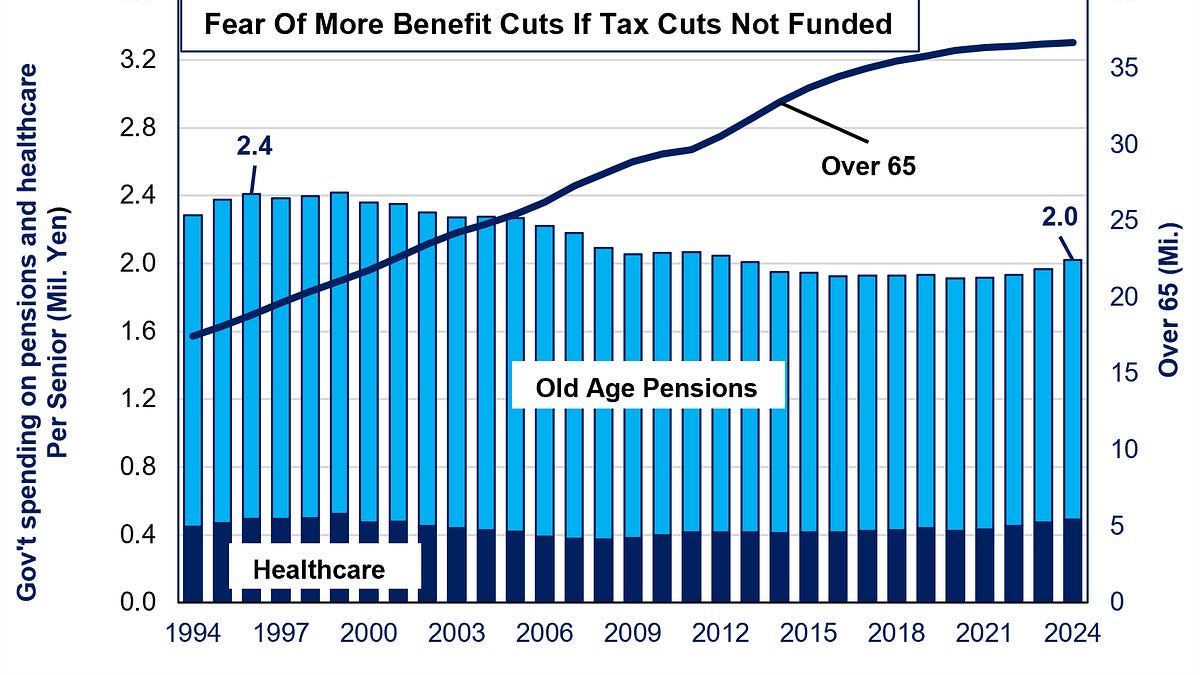
Source: https://www.esri.cao.go.jp/en/sna/data/kakuhou/files/2024/tables/2024s9_en.xlsx Note: A 17% cut per senior from 1996 to 2024 in spending per senior in cash or kind; 2.0 million and 2.4 million, respectively, include both healthcare and pensions A great scenario for Japan could emerge if some current political impulses align. All parties are pushing for some combination of tax cuts and cash handouts to help Japan’s poor and middle-class citizens in the face of inflation. Yet, since none of the significant parties is willing to pay for this largesse, the size of the tax cuts and cash handouts is limited and mostly temporary. Moreover, even voters who support the benefits fear that, if left unfunded, they could lead to further cuts to social welfare benefits such as health care and old-age pensions (see the chart above showing a 17% cut in benefits per senior over the last three decades). While rolling back some of the enormous cuts in corporate income taxes would enable Japan to afford larger and more permanent benefits easily, none of the significant parties currently support this idea, and the leadership of the Liberal Democratic Party (LDP) and its allies are, for the most part, adamantly opposed. On the other hand, the Democratic Reform Party (DRP) has already declared its desire to reform the corporate tax, but in the future. Most importantly, a group of security hawks in the government in charge of planning expanded defense spending advocates a hike in the corporate income tax to help pay for this. If and when the taboo against corporate tax hikes is broken, the notion of using such hikes to pay for social benefits, and not just defense, could appeal to more of the players. The notion of tax cuts and cash handouts to counter falling living standards has moved to the front burner of Japanese politics. This happened because the LDP lost its majority in the Lower House in October 2024 and then the Upper House in July 2025 due to Prime Minister Shigeru Ishiba’s adamant opposition to the consumption tax cuts being pushed by the opposition parties. So, current Prime Minister Sanae Takaichi says cutting the food tax has always been a cherished wish, although there is no evidence of that. But when opportunism leads politicians to act in ways that improve living standards, that’s a good thing. Currently, the parties are deadlocked over what kind of tax cut, and how big, it should be. Not a single opposition party supports Takaichi’s proposal, and the LDP-led coalition lacks a majority in the Upper House. While minority parties can delay or perhaps extract some concessions, the LDP’s two-thirds majority in the Lower House means it can overrule the Upper House on this matter if necessary. In several August polls, the public narrowly supported the government’s proposal to cut the food tax from 8% to 1% for two years. At the same time, most people worried it could make it difficult for the government to sustain its social security system. Those fears are well-founded. As the number of people over 65 doubled from 17 million to 37 million during 1994-2024, the government slightly lowered the share of GDP devoted to spending on healthcare and old-age pensions (see chart below). It did so by cutting the yen spent per senior by 17%, from a peak of ¥2.4 million ($24,000 Purchasing Power Parity or PPP) in 1996 to ¥2.0 million in 2024 (see the chart at the top of this post). Note: 12.4% and 11.7% respectively include both healthcare and pensions The good news is that defense/fiscal hawks in both the LDP and the government are pushing for a partial rollback of past corporate tax cuts to pay for big hikes in defense spending. On October 18, Kyodo reported that “A plan to additionally increase corporate tax to fund a boost in Japan’s defense spending is being floated within the government of Prime Minister Sanae Takaichi.” One source told Kyodo, “Large and midsize companies have accumulated retained earnings, making it difficult to oppose a corporate tax hike.” How big a hike they’ll propose—and Takaichi will accept—remains to be seen. This refers to the huge stash of hoarded cash companies have accumulated through outsized profits from wage suppression. This hoard now amounts to 100% of GDP (see this post and the chart below). Source: https://www.mof.go.jp/english/pri/reference/ssc/historical/all.xls Some members of the LDP’s Defense Policy Committee share this sentiment, according to Tobias Harris, a political analyst who publishes Observing Japan. Harris said these members worry they can’t sustain lasting increases in defense spending unless they are paid for, and the available money sits in corporate coffers. I would not be surprised if these defense/fiscal hawks oppose cuts in personal taxes. However, once there is a break in both dams—being able to cut personal taxes and to raise corporate taxes for defense—those interested in personal tax cuts could latch onto corporate taxes as a way to finance this. The Politics and Size of Tax Cuts For People Today’s debate is the first time in two decades that proposals to reverse the stagnation in living standards have moved to the front burner of the political agenda. In 2007, under pressure from opposition parties that had won that year’s Upper House election, the LDP revised the minimum wage law to ensure no full-timer earned less than people on welfare. In 2010, when the Democratic Party of Japan briefly took power, it set in motion an annual 3% minimum wage hike and set a goal of ¥1,000 per hour. In 2015, LDP Prime Minister Shinzo Abe picked up that baton to help defeat deflation. The latter effort has lifted 20 million out of poverty or near-poverty levels (see this post). Unfortunately, compared with the minimum wage measures, the tax cuts on today’s agenda are relatively small, and some are temporary. Still, once the precedent is set, the size might expand if a funding source can be found. The biggest move so far is a hike in the “zero tax bracket” regarding personal income. Beginning in January, this will lower the income tax on someone earning ¥4 million ($40,000 PPP) a year by ¥113,000, i.e., about 3% of their income. That’s not tiny, but much of this gain will be wiped out by inflation. Moreover, unlike a minimum-wage increase, it does not raise the growth rate of after-tax income. With this benefit capped at an income of ¥6.65 million, Asahi estimates that this would benefit at least 80% of people. This happened because, after the LDP’s election losses and Ishiba’s resignation, Takaichi could not form a government without support from the smallish conservative Democratic Party for the People (DPFP). Raising the zero-tax bracket was that party’s signature campaign promise. The annual cost of going from ¥1.03 million to ¥1.78 million is estimated at around ¥5 trillion (a bit less than 1% of GDP). At that time, the opposition also wanted cuts in the consumption tax. Takaichi ultimately proposed cutting the food tax from 8% to 1%, but only for two years and not on any other items, most of which are taxed at 10%. The opposition parties no longer recommend cutting the consumption tax but are proposing alternative measures. However, because these cuts lack funding, the proposed amounts are far too small to improve living standards substantially. Komeito has proposed a flat benefit of ¥40,000 ($400 PPP) per person for two years. That’s about 1% of the median salary. ¥40,000 is also the proposal of the new Democratic Reform Party, formed by CDP Lower House members after the latter’s bloc with Komeito fell apart. These parties say this would cost the same as a cut in the food tax, but could be implemented faster and more easily. The DPFP has proposed a one-time ¥50,000 handout for the poor and middle class. The LDP itself has proposed a ¥30,000 one-time handout for about 20 million people. The next step the LDP and several opposition parties are discussing is the “Refundable Tax Credit,” similar to the Earned Income Tax Credit (EITC) in the US. Takaichi’s plan would provide an average of just ¥30,000 ($300 PPP) per year to about 20 million people earning between ¥1 million and ¥3.5 million per year, i.e., most of the lower half of income earners. Those earning less than ¥1 million already get some welfare benefits. This will benefit people whose income is so small that they pay too little in tax and social insurance premiums to take full advantage of available deductions. This will give them cash equal to the deductions for which they would have been eligible. However, this amount is tiny. In the US, by contrast, in 2024, 24 million people received an average benefit of about $2,894. Households with three or more children can receive up to $7,830. This, too, does nothing to boost the rate of income growth over the years. Moreover, unless a way is found to pay for these benefits, the size is unlikely to be raised. How To Pay: The Corporate Tax As I detailed in a recent post, rolling back the huge cuts in the corporate income tax over the past few decades could easily fund even larger tax cuts for people, whether it be the consumption tax or the personal income tax. Because of 35 years of wage suppression, corporate profits soared from 4.4% of GDP in 1994 to a stunning 17.6% in 2024. But due to four decades of corporate tax cuts, revenue from corporate taxes was little higher in 2024 than in 1994 (3.3% of GDP vs. 2.9%). If corporate tax rates had remained the same, the revenue from corporate taxes would have risen to 9.3% of GDP (see chart below). That difference of 6 percentage points of GDP is far more than is needed to pay for even larger tax cuts for people without increasing the budget deficit. In fact, it could be used to lower the deficit while still leaving companies with plenty of money to invest more and to raise wages. Source: https://www.esri.cao.go.jp/en/sna/data/kakuhou/files/2024/2024annual_report_e.html The only significant party talking about this is the Democratic Reform Party (DRP), composed of 21 Lower House members formerly in the Constitutional Democratic Party (CDP). The CDP had called for lowering the consumption tax and raising the corporate tax back in 2020 but then renounced the idea when former Prime Minister Yoshihiko Noda joined the party and quickly became its leader. Now that Noda is gone as leader, the DRP is putting that issue of the agenda once the current tax and benefit debate is concluded. At an October 20 press conference, DRP Secretary-General Takeshi Shina declared that, “The second point is to switch to a permanent income-reflective benefit one year after the 40,000 yen is paid. First, securing funding is the priority, and we will secure it through a fundamental reform of the tax system that requires high-profit corporations, high-income individuals, and corporations/individuals with large assets to bear their fair share.” Whether this will amount to more than tokenism remains to be seen. Support the Blog Paid subscribers are eligible for my new memos, in addition to these regular posts. Beyond that, if you feel you’ve gained insight from this blog, ever restacked it, if you ever subscribed to my previous publication, The Oriental Economist Report, and certainly, if you or your firm have gained insights that helped guide your investments, please support the blog with a subscription or by “buying me a cup of coffee.” You can buy a cup or two on a one-time basis, or once a year, or once a month.
~8 min read · 1922 words